
Background:
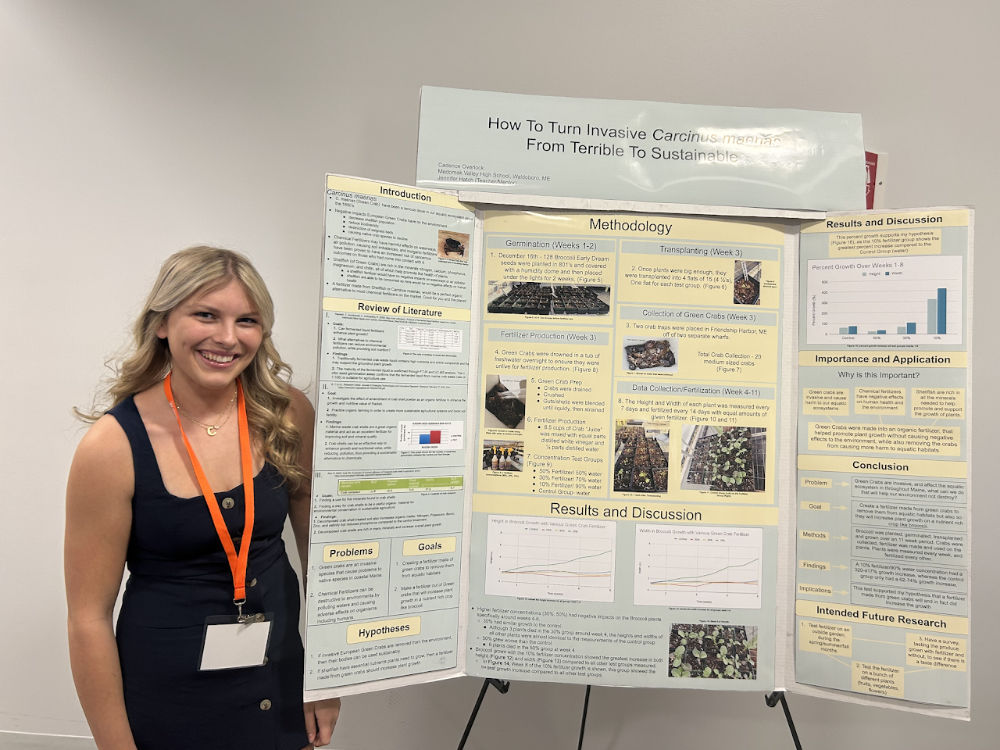
Medomak High School student Cadence Overlock wanted to study whether kelp would have a positive effect on the growth of clams through the buffering effect it has on seawater. Boothbay Sea and Science Center assisted her in this study by providing equipment, setup and sugar kelp seedlings. Below is the abstract from her study which was completed in 2026:
The effects of climate change on ocean water are becoming more prominent throughout the years, and are causing negative effects on aquatic life, specifically those that have shells. In several studies, kelp has been shown to mitigate the effects of climate change on ocean water, which significantly affects clam productivity, growth, density, and life. Kelp does this by absorbing carbon dioxide through photosynthesis, buffering against the effects of ocean acidification and raising the pH back to suitable levels. The goal of this project was to examine the effects of Saccharina latissima (sugar kelp) on sea clam growth, how it affected the pH and overall conditions for clam life. I hypothesized that clams grown with kelp will grow faster than those grown without. Sea clam spat were grown for two months with sugar kelp in 10 beakers, 5 with kelp, and 5 without at 10-11ºC. Each beaker contained 4 spat, was aerated and instant ocean water was changed weekly maintaining a salinity of 33 ppt. Each clam beaker was fed 20.1µL of concentrated algal phytoplankton daily. Due to unpredicted abiotic stressors, the clams died prematurely, and the data growth measured in the test groups did not show a significant difference. Thus, the hypothesis was rejected. Future studies would aim to get larger kelp that could be replaced more often and try to maintain steady environmental conditions including temperature. In addition, measuring changes in water chemistry could be valuable.