
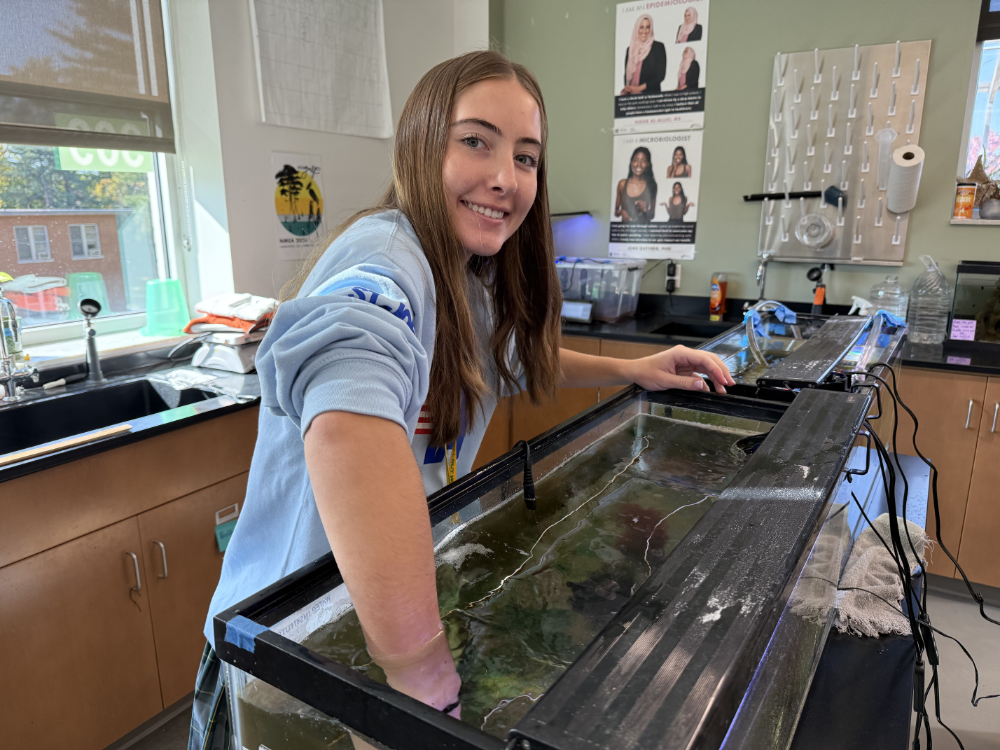
St. Joseph’s Academy (St. Louis, Missouri) student Izzy Mancini is one of two students working with BSSC on a project studying seaweed’s tolerance to temperature changes and the impact it has on the ecosystem of clams and mussels. Below are some of her observations from the experiment so far:
Data collection has been progressing well, and the results are quite interesting. The heaviest kelp strand is found in the cooler water tank, which is not surprising; as of December 1, 2025, it weighed 14.20 grams. In the cooler water tank, the mass typically increases each week, and the blade length is also growing. The kelp strands are becoming denser. The temperature in this tank has remained consistent at around 53 degrees Fahrenheit. In Tank A, there is some algae growth, but it is only accumulating on the sides of the tank and not on the kelp strands, so I believe the mass measurements are accurate. In contrast, Tank B is experiencing significant algae growth both in the tank and on the strands. In the first three weeks of collection, it was evident that the mass of each strand was decreasing. However, with the increase in algae growth on the strands, the mass has now begun to increase. It appears that this increase is primarily due to the algae taking over. There is red algae present in both tanks, but it is more noticeable in the warmer water tank. The mussels in this tank appear to be completely dead. The health of the mussels in Tank A is poor, and there are no signs of growth improvement, leading me to believe that the temperature difference is the main factor.